Saturday, May 21, 2011

Q4 Biography

Margaret Geller Bio 
     Margaret Geller, a magnificent American astronomer and professor, was born in 1948 to Seymour Geller and Sarah Levine Geller. The daughter of a crystallographer from Ithaca, New York State, Geller was encouraged as a small child to study science and mathematics. Her education includes a B.A from the University of California, Berkeley in 1970, a M.A from Princeton University in 1972, and a Ph.D. from Princeton University in 1974. After a period at the Institute of Astronomy, Cambridge, England, Geller moved to Harvard in 1980 and was appointed professor of astronomy in 1988.

     Since the early 1980s Geller and her coworkers have been carrying out for the Center for Astrophysics (CfA) a red-shift survey of some 15,000 galaxies. The intention is to map all galaxies above a certain brightness, out to about 650 million light years, in a particular sector of the heavens. They were aware that to some observers the sky lacked the uniformity predicted by the big-bang theory. In 1981, for example, a 100-million-light-year gap had been discovered in the constellation Bootes. Geller considered the possibility that this was a local phenomenon, and that the predicted homogeneity would become more apparent on a much larger scale. Further investigations were expected to show a uniform distribution of galaxies.

     But when they came to plot the distribution of galaxies they saw neither a uniform spread, nor a random scattering of galaxies, but large-scale clusters grouped into enormous structures. The largest of these, dubbed the Great Wall, stretches for more than 500 million light-years. It was difficult to see how anything as massive could have been formed within the context of current cosmological theory; when Geller reported the initial results of the CfA survey in 1989 she noted, “Something fundamental is missing in our models.”The existence of this structure, the largest ever seen in the universe, presents a conundrum for theorists dealing with the early universe. She has been mapping the nearby universe for the past sixteen years and has produced the most extensive pictures yet.

      She is also a staff member of the Smithsonian Astrophysical Observatory.She is interested in mapping the distribution of the mysterious, ubiquitous dark matter in the universe, the halo of our own galaxy, the Milky Way, to understand the link between the history of our Galaxy and the history of the universe. She does this by mapping clusters of galaxies to understand how these systems develop over the history of the universe, and measuring and interpreting the signatures of star formation in the spectra of galaxies to understand the links between the star formation in galaxies and their environment. She leads a program called SHELS.

     Geller won a MacArthur fellowship- also know as a "genius award" - in 1990 for her research. SHe received the Newcomb-Cleveland Prize of the American Academy of Arts and Sciences that same year. In addition to galaxy distributions, Geller is interested in the origin and evolution of galaxies and X-ray astronomy. She is a member of the International Astronomical Union, the American Astronomical Society, and the American Association for the advancement of Science. 

Friday, May 20, 2011

APOD 4.7

The Sombrero Galaxy from Hubble
Named the sombrero galaxy for its hat-like resemblance, M104 features a prominent dust lane and a bright halo of stars and globular clusters. Reasons for its hat-like appearance include an unusually large and extended central bulge of stars, and dark prominent dust lanes that appear in a disk that we see nearly edge-on. Billions of old stars cause the diffuse glow of the extended central bulge. The very center of the Sombrero is thought to host a black hole! It's a really awesome picture to look at.

Monday, May 16, 2011

Margaret Geller Bio Sources

"ASP: Women in Astronomy: An Introductory Resource Guide to Materials in English."Astronomical Society of the Pacific. Web. 16 May 2011. <http://www.astrosociety.org/education/resources/womenast_bib04.html>.


Lawler, Andrew. "Margaret Geller: Battling Discrimination or Bureaucracy?" Science. American Association for the Advancement of Science, 12 Nov. 1999. Web. 16 May 2011. <http://www.sciencemag.org/content/286/5443/1277.short>.


"Margaret Geller's SAO Home Page." Margaret Geller. Web. 16 May 2011. <https://www.cfa.harvard.edu/~mjg/>.

Tuesday, May 10, 2011

APOD 4.6

Globular Cluster M15 from Hubble 
Stars swarm around the center of the bright globular cluster M15. This ball of over 10,000 stars is still here from the earliest years of our galaxy and continues to orbit the Milky Way's center. M15 is one of only 150 globular clusters remaining and can only be seen with binoculars. It's center has one the densest concentrations of stars known and contains a high abundance of variable stars and pulsars. This image was taken by the Hubble Space Telescope and spans about 120 light years.


Friday, April 29, 2011

APOD 4.5

The Antennae 
THIS IS SO COOL WE JUST LEARNED CORVUS! Some 60 million light-years away in the southernly constellation corvus, two large galaxies collided. But the stars NGC 4038 and NCG 4039 didn't collide. Instead, their large clouds of molecular gas and dust do, trigerring furious episodes of star formation near the center of the cosmic wreckage. This view spans 500 thousand light years.

Thursday, April 21, 2011

APOD 4.4

Peculiar Galaxies of Arp 273
The spiky stars in the foreground are well within our own Milky Way Galaxy. The two eye-catching galaxies lie far beyond the Milky Way at a distance of over 300 million light years. Their distorted appearance is due to gravitational tides as the pair engage in close encounters. From our perspective, the bright cores of the Arp may offer an analog of their far future encounter. The release of this vista celebratesthe 21st anniversary of the Hubble Space Telescope in orbit!

Monday, April 18, 2011

Zooniverse

For my Zooniverse project I have been planet hunting like there's no tomorrow. It rocks when they test you for a transit feature and you correctly identify them!

Friday, April 15, 2011

APOD 4.3

Young Stars in the Rho Ophiuchi Cloud 
Dust clouds and embedded newborn stars glow at infrared wavelengths in this false-color composition from WISE. This features one of the closest star-forming regions , part of the Rho Ophicuhi cloud complex some 400 light years distant. After forming along a large cloud of molecular hydrogen gas, young stars heat the surrounding dust to produce the infrared glow. Stars in the process of formation, called young stellar objects, (YSOs) are embedded in the pinkish nebulae seen here . 

Friday, April 8, 2011

Observations

Last night I went out in my driveway at about 10pm. Of course I saw Orion, Betelgeuse, and Rigel. I also managed to identify Gemini, and its two main sequence stars Castor and Pollux. I spotted Sirius and perhaps Lepus, but I'm not really sure.

APOD 4.2

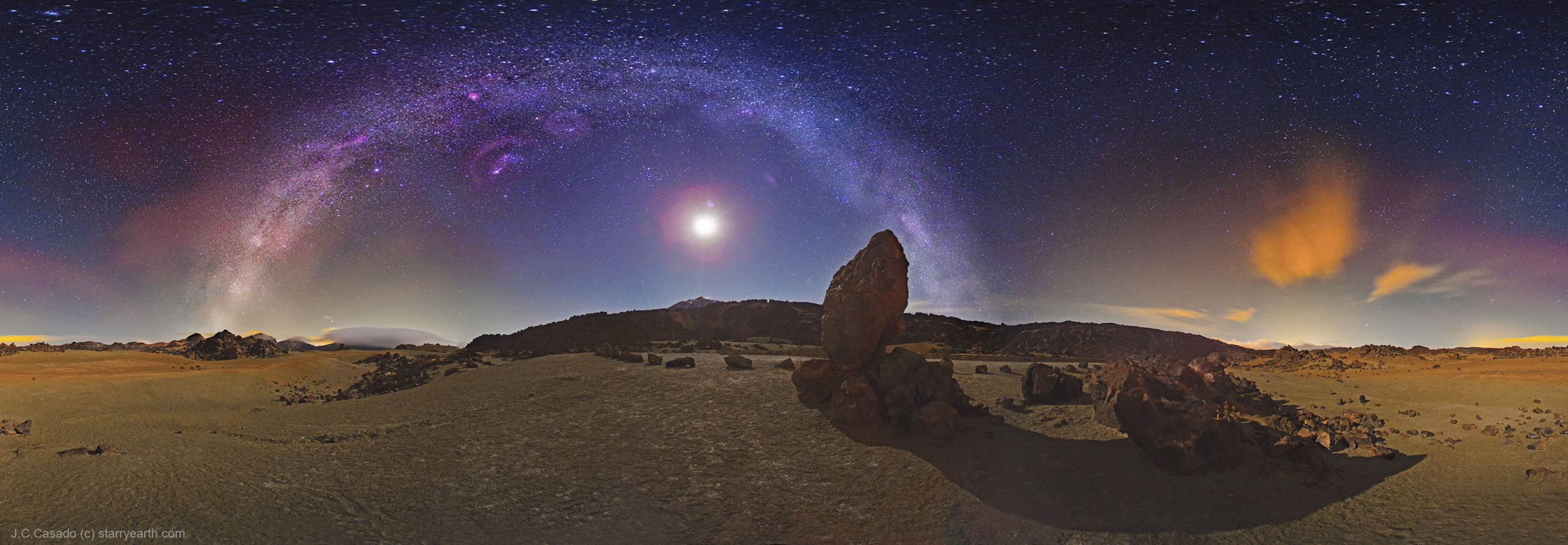
The Milky Way Over Tenerife 
In a clear sky from a dark location at the right time, a faint band of light, the disk of our spiral galaxy, is visible across the sky. Since we are inside this disk, the band appears to encircle the earth. The image is actually a deep digital fusion of nine photos that create a panorama fully 360 across. Also depicted is a waxing moon, Barnard's loop, and the Pleiades. 

APOD 4.1

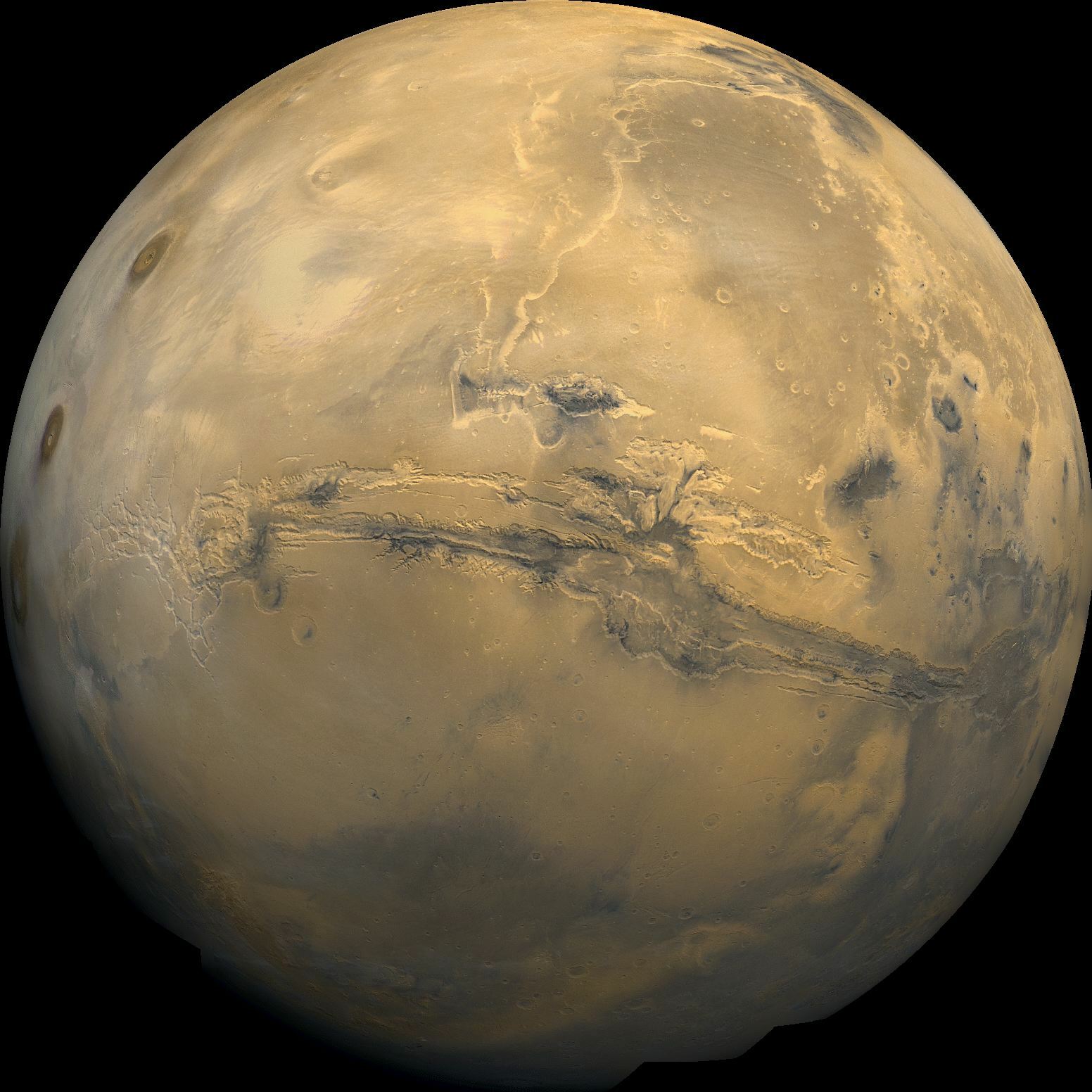
Valles Marineris 
Valles Marineris is the largest canyon in the solar system extending over 3,000 kilometers long and spanning as much 600 kilometers across and delving as much as 8 kilometers deep. The origin remains unknown, although a hypothesis stands that it started as a crack billions of year ago as the planet cooled. This pictured was compiled from over 100 images of Mars taken by Viking Oribiters in the 1970s.

Thursday, March 24, 2011

APOD 3.8

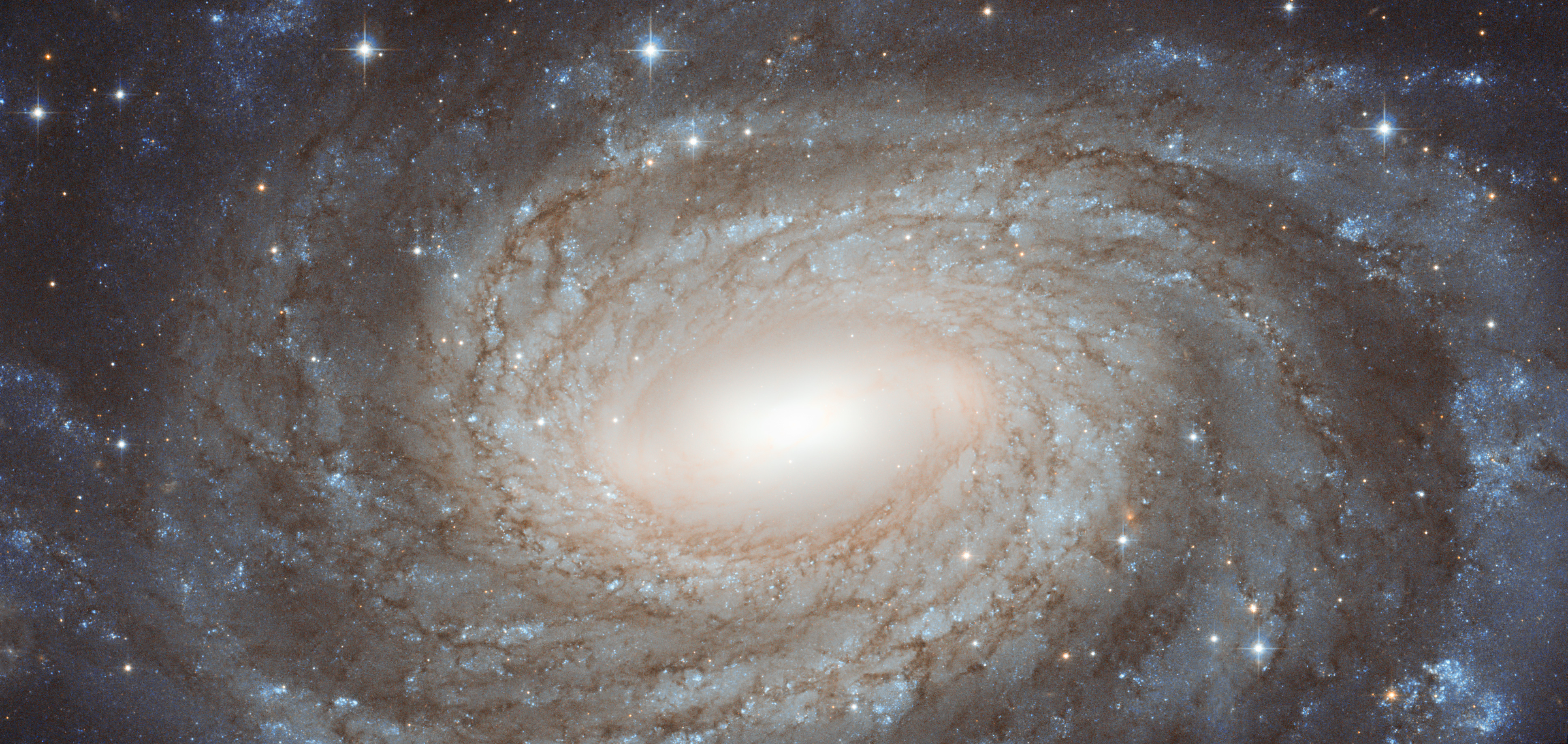
NGC 6384: Spiral Beyond the Stars
To see galaxies within the universe, astronomers must look out beyond the stars of our galaxy, the milky way. The image above shows spiral galaxy NGC 6384 abour 80 million light years away in the direction of the constellation Ophiuchus. It spans an approximate 150,000 light-years. You can see the galaxy's blue spiral arms and yellowish core.

Thursday, March 17, 2011

Observation 3/17/11

I went outside on my driveway at about 9:30 pm. Directly overhead was a bright full moon. What was special about this observation today, was that there was a lighter aura circling the moon - an effect of the atmosphere. When I saw the star Betelgeuse in the constellation Orion, I couldn't stop thinking about The Universe Video we watched in class today and how at any moment - tomorrow, 100 years - Betelgeuse will explode into a supernova!! Pretty neat.

Friday, March 4, 2011

APOD 3.7

Saturn's Hyperion: A Moon with Odd Craters
Nobody is sure what lies at the bottom of Hyperion's strange craters. The robot Cassini spacecraft (which is now orbiting Saturn) swooped past the the sponge-textured moon in 2005 and 2010 and took images with unprecedented detail. The picture above is an image from 2005 shown in false color and depicts a remarkable world strewn with strange craters and a generally odd surface. The slight differences in color most likely show differences in surface composition. Hyperion is about 250 kilometers across, roatates chaotically, and has a density so low it might house a vast system of caverns inside.


Friday, February 25, 2011

APOD 3.6

Mammatus Clouds Over Olympic Valley 
Normal cloud bottoms are flat because warm moist air that rises and cools condenses into water droplets at specific temperatures. This corresponds to a very specific height. An opaque cloud forms after the water droplets form. Cloud pockets can develop that contain large droplets or ice that fall into clear air as they evaporate. Such pockets may occur in turbulent air - like near the top of an anvil cloud for example. These mammatus clouds were photographed over Olympic Valley, CA. 

Thursday, February 24, 2011

Edward Pickering Bio


Edward Pickering was a prominent American astronomer who pioneered the development of the color index method for cataloging stars and who encouraged many young scientists in astronomy, including many women (which was unusually for the time). Pickering graduated from Harvard and then taught physics for 10 years at the Massachusetts Institute of Technology where he built the first instructional physics laboratory in the United States. Appointed at age 30 as director of the Harvard College Observatory, he served in this post for 42 years.

He and his staff made visual photometric studies of 45,000 stars. With funds provided by Henry Draper's widow, Anna Palmer Draper, he hired a number of women, including Williamina Fleming, Annie Jump Cannon, Antonia Maury, and Henrietta Levaitt, and produced the Henry Draper Catalogue with objective prism spectra of hundreds of thousands of stars classified according to Cannon's “Harvard sequence.” He established a station in Peru to make the southern photographs and published the first all-sky photographic map. He and Hermann Vogel (1842–1907) independently discovered the first spectroscopic binary stars. He also discovered a new series of spectral lines, now known as the Pickering series, that turned out to be due to ionized helium. Pickering encouraged amateur astronomers and was a founder of the American Association of Variable Star Observers.

Pickering made innovations in spectrography. Instead of placing a small prism at the focus to capture the light of a single star, he put a large prism in front of the objective, obtaining at the same time a spectrogram of all the stars in the field sufficiently bright to affect the emulsion. This made possible the massive surveys he wanted to organize and enabled the publication in 1918 of the Henry Draper Catalogue, compiled by Annie Cannon, giving the spectral types of 225,300 stars. The other innovation in instruments due to him was the meridian photometer introduced in 1880. In this, images of stars near the meridian would be reflected at the same time as the image of Polaris. The brightness could then be equalized and as the brightness of Polaris was known, that of the meridian stars could easily be calculated. More than a million observations with such instruments permitted the compilation of the Harvard catalog giving the magnitude of some 50,000 stars. He was able to include stars of the southern hemisphere in this catalog, for in 1891 he had established an observatory in Arequipa, Peru, with the help of his brother William Henry Pickering and published the first all-sky photographic map. He and Hermann Vogel (1842–1907) independently discovered the first spectroscopic binary stars. He also discovered a new series of spectral lines, now known as the Pickering series, that turned out to be due to ionized helium. Pickering encouraged amateur astronomers and was a founder of the American Association of Variable Star Observers.


Monday, February 21, 2011

Pickering Bio Sources (Q3)

"The Bruce Medalists: Edward C. Pickering." SSU Department of Physics & Astronomy - Home. Web. 21 Feb. 2011. <http://www.phys-astro.sonoma.edu/BruceMedalists/Pickering/index.html>.


"Edward Charles Pickering (American Physicist and Astronomer) -- Britannica Online Encyclopedia." Encyclopedia - Britannica Online Encyclopedia. Web. 21 Feb. 2011. <http://www.britannica.com/EBchecked/topic/459405/Edward-Charles-Pickering>.


Stone, David. "Edward Pickering." Boise State University Department of Mathematics. 10 Mar. 2003. Web. 21 Feb. 2011. <http://math.boisestate.edu/gas/whowaswho/P-Q/PickeringEdward.htm>.

Observations

Last night (2/20/11) I went to the stargaze at PV.
I saw so many things including Orion, Lepus, Canis Major, Jupiter, the Pleadis, Gemini, and ten 1st magnitude stars(Betelgeuse, Rigel, Canopis, Sirius etc) among many others. We made out the Heavenly G in the sky like we do in Starlab.  I wish I could get out to these more often! It was really awesome to apply what I've learned on paper to the night sky.

Friday, February 18, 2011

APOD 3.5

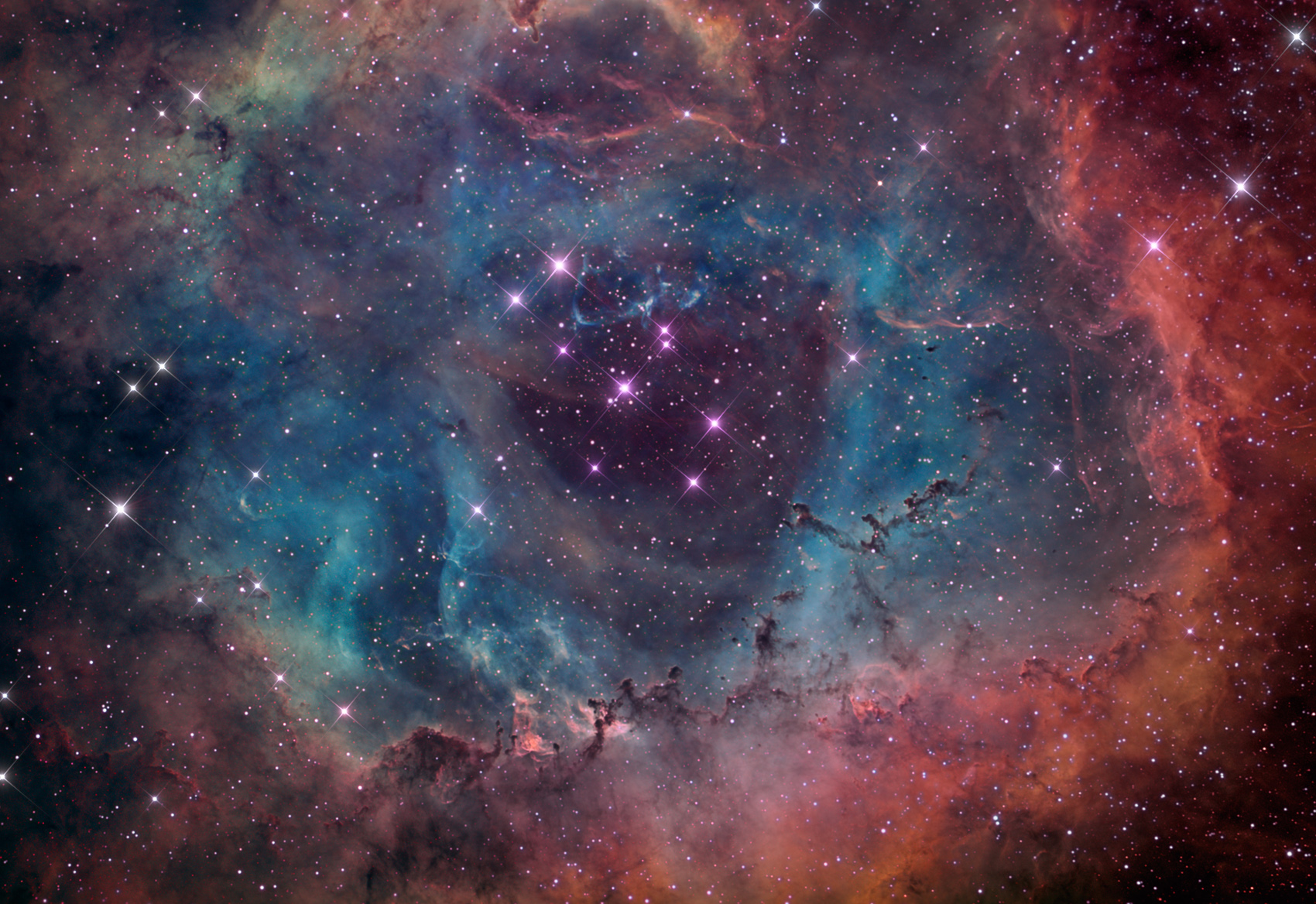
Rosette Nebula 
This picture reminds me so much of a flower! The colors are all very aesthetically pleasing. Inside the nebula lies an open cluster of bright young stars called NGC 224. These stars formed about 4 million years ago from the nebular material and their stellar winds clearing a hole in the nebula's center - insulated by a layer of dust and hot gas. Ultraviolet light causes the nebula to glow. It can be seen towards the Monoceros and lies about 5,000 light years away!. (Spans about 100 light years across. 

Friday, February 11, 2011

APOD 3.4

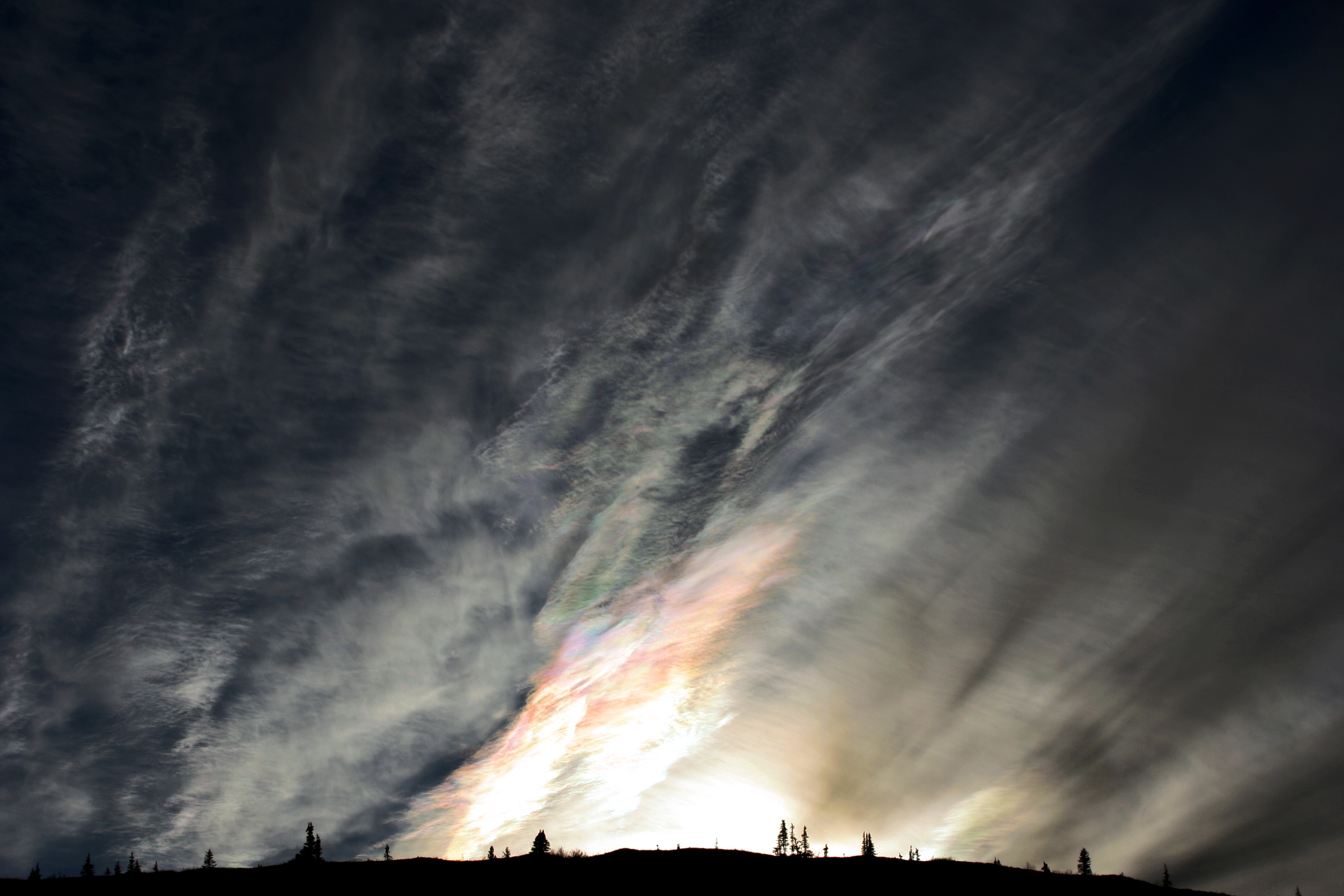
Iridescent Clouds from the Top of the World Highway
A rare phenomenon known as iridescent clouds can show vivid unusual colors or a whole spectrum simultaneously making clouds appear to be different colors. These clouds are formed by small water droplets of the apparent same size. When the sun is hidden behind these thinner clouds, (as well as being in the right position), the thinner clouds diffract the light in coherent manner with different colors being deflected by different amounts. This awesome picture was taken last year outside Dawson City in the Yukon Territory in Northern Canada.